
A data center is a physical facility designed to store vast amounts of servers used by various industries. These centers are equipped with a range of complex components—like cooling systems, power supplies, and security measures—to support hundreds or even thousands of servers. To ensure smooth operations, it’s crucial for data centers to maintain strict operational procedures that mitigate risks such as system failures, natural disasters, and downtime. This is why maintenance plays a key role in the care of a data center.
Data center maintenance involves routine inspection, monitoring, and evaluation to ensure the operational efficiency and quality of facilities. This process is crucial for preventing potential failures by regularly checking various components of a data center and identifying issues before they arise.
For example, examining hardware components like cooling systems and Uninterruptible Power Supplies (UPS) ensures they are functioning properly. Additionally, updating software to the latest versions helps minimize bugs and vulnerabilities.
There are three main types of data center maintenance, each with different core objectives: preventive, reliability-centered, and predictive maintenance.
Preventive maintenance is the most common and widely used type due to its cost-effectiveness and simplicity. As the name suggests, its purpose is to prevent and mitigate risks associated with system failures or declines in the quality of both hardware and software.
In contrast to preventive maintenance, reliability-centered maintenance specifically targets the inspection of critical components to assess their reliability within the system. This type of maintenance is crucial, as data centers support hundreds or even thousands of clients from various industries, and failures can result in significant losses.
While preventive maintenance focuses on routine checks, predictive maintenance aims to identify potential issues before they cause damage by utilizing data analysis and monitoring tools. For instance, monitoring fluctuations in humidity levels can help detect temperature-related problems early on.
Regular maintenance surely brings a lot of benefits for a data center. Let’s dive deeper to their benefits:
Over time, the quality of equipment and operations can degrade, leading to technical problems and decreased performance. Regular data center maintenance ensures that equipment, standard operating procedures (SOPs), and facilities remain in optimal condition, allowing for stable and efficient operations.
Data centers can save costs by identifying potential risks before they escalate into significant issues, which could negatively impact customer experience and satisfaction. By mitigating risks early, data center maintenance not only prevents costly downtime but also promotes energy savings by optimizing resource allocation.
As mentioned earlier, data center maintenance encompasses three distinct types aimed at alleviating risks. This is crucial, as data centers house numerous servers that are vulnerable to threats such as malware and physical disruptions. By implementing a strict maintenance strategy, data centers can protect their infrastructure and ensure continuous service.
Data center maintenance isn’t just a routine task; it’s the backbone of reliability and efficiency in today’s data-driven world. By implementing our three targeted maintenance strategies, you can ensure that your facilities operate at peak performance while minimizing risks. As one of the most cutting-edge colocation data centers in Indonesia, EDGE DC provides high-quality services with regular maintenance to ensure optimal performance and reliability for our clients. Our expert team conducts frequent, thorough inspections of our equipment while also prioritizing security through strict protocols. Don’t leave your critical infrastructure to chance—connect with our expert team today to discover how we can help you with our services!
The internet has experienced significant growth over the past decade, offering vast amounts of content across various platforms and types of media accessible in many countries. People can transfer data from one to another in real-time with unique features that help them deliver content. However, people face the challenging sides of the internet should the people send it across the world at some times. Thus, companies and websites usually use Content Delivery Network or known as CDN for a better performance.
A Content Delivery Network (CDN) is a group of interconnected servers distributed geographically closer to the end user, designed to deliver cached internet content1such as images, videos, and HTML1quickly and efficiently. This efficiency and high speed have contributed to the growing popularity of CDNs, enabling major global companies to significantly enhance their web performance and effectively manage large-scale traffic. Common CDN providers are: Cloudflare, Fastly, Gcore. Major companies and website owners should consider using a Content Delivery Network (CDN) to enhance content delivery and facilitate smoother transfers from interconnected servers across the globe. By utilizing a CDN, businesses can significantly improve user experience, leading to higher customer satisfaction and encouraging repeat visits.
CDN works by temporarily storing files and content on distributed servers around the globe. This enables efficient data transfer by allowing users to access data from servers that are closer to them. This process, known as caching, helps improve load times and reduce latency. The process of caching is central to how CDNs operate. By storing copies of web pages, images, videos, and other types of content, CDNs reduce the distance that data must travel, which minimizes latency and improves load times. This is especially important for websites with high traffic or for streaming services where quick access to data is crucial for user experience.
CDN serves many benefits as following:
With interconnected servers, companies or website owners can send cache much quicker by having a closer network to the users. Therefore, users can receive contents and information with minimal latency, making them stay in the site longer.
One of the main expenses in hosting a website is bandwidth cost. By CDNs, websites can reduce said cost and optimize data transmission through caching.
Aside from delivering content, CDN can also improve security to ensure data protection by few services. For instance, providing distributed-denial-of-service (DDos), web application firewalls (WAFs), SSL/TLS encryption.
Faster speed and minimal latency creates improved website performance overall. Users can load sites smoothly without encountering issues that cause them to bounce out of the page. Additionally, companies and website owners can manage larger traffic in different locations better.
In summary, a Content Delivery Network (CDN) plays a vital role in delivering content and managing traffic for users across various locations. By leveraging a network of distributed servers, CDNs ensure that data is stored closer to users, which significantly reduces latency and enhances loading speeds. This is particularly important in our increasingly globalized world, where users expect instant access to content regardless of their geographical location.
Data center commissioning is crucial for shaping our digital future by making sure these essential facilities are built and run smoothly. As technology advances with new tools like artificial intelligence and smart devices, good commissioning helps data centers keep up with these changes and support our connected world. In short, it’s key to making sure technology can drive progress and improve our digital lives.
Data center commissioning is a process where owners review, verify, and test all of the components needed to operate data centers, from the facility design and equipment specifications to the Standard Operating Procedure (SOP), to ensure seamless operation and meet the standard requirements. This process is highly important since it minimizes potential risks and disasters which can directly impact the customers orders and experience. Data center commissioning hires related experts and authority to inspect their facilities, system, and procedure, with evaluation, guidance, and advice.
Data center commissioning is an important and valuable step to establish a solid foundation. Let’s take a look at their benefits below:
With comprehensive and strict procedures, data center commissioning helps by ensuring that all of the equipment and integrated system are properly installed and well functioning. It also helps by evaluating issues and malfunction early on before fully operating.
As we all know, repairing a data center while fully operating can be costly with a lot of different things to cover. By investing in data center commissioning, companies can significantly cut expenditures for potential risks and unwanted threats that could cause havocs.
Human resources is one of the most vital things to operate data centers. Hence, having teams with related experiences, skills, and knowledge, will significantly improve the quality of the operation activities because of their expertise and familiarity with all of the parts.
By prioritizing energy efficiency and resource conservation, Leadership in Energy and Environmental Design or LEED sets standards for the design, construction, and operation of buildings, ensuring they contribute to a healthier, more sustainable environment. It is a green building certification that requires commissioning which is widely known and used globally.
With its role in adapting to technological advancements and contributing to certifications like LEED, data center commissioning is crucial for driving progress and fostering a connected, efficient, and environmentally responsible digital future. In EDGE2, we successfully commissioned our data center by building a well foundation through comprehensive and strict procedures to have teams with related experiences, skills, and knowledge. Reach out to our expert teams for more information and enquiries.
In an interconnected digital world, efficient data exchange is key. One of the most effective strategies to achieve this is through network peering, an approach that allows two networks to connect and exchange traffic directly without involving a third party. This direct connection can significantly reduce latency, cut costs, and improve network performance.
However, not all peering is created equal. There are several types of network peering, each with unique characteristics and use cases. Understanding these differences is crucial for choosing the model that best suits your business needs. If you’d like to understand the basics of network peering first, you can read our article on What is Network Peering?.
Here are the three main types of network peering you need to know:
Private peering is the most direct form of connection. It involves creating a dedicated point-to-point link between two networks. This connection is typically established within a data center colocation facility via a physical cross-connect.
Unlike private peering, public peering enables a many-to-many connection. This takes place at a centralized location called an Internet Exchange Point (IXP). Within an IXP, dozens to hundreds of networks—including ISPs, Content Delivery Networks (CDNs), and enterprises—can connect to each other via shared switching infrastructure. Popular IXPs in Indonesia include Indonesia Internet Exchange (IIX) and Open IXP (OIXP), which facilitate efficient domestic traffic exchange.
Paid peering, sometimes referred to as partial transit, is a hybrid model. In this scenario, a financial arrangement occurs where one network pays another for peering access. This often happens when a smaller network wants to peer with a very large Tier-1 network to gain access to that large network’s routes and customers.
Choosing between private, public, or paid peering is a strategic decision that depends on your traffic volume, number of partners, budget, and performance goals. For many businesses operating in Asia, public peering through a reliable Internet Exchange (IX) offers the best combination of cost-efficiency, scalability, and improved performance.At Digital Edge, we introduce EPIX (Edge Peering Internet Exchange), an ultra-high-speed, carrier-neutral IX platform designed to optimize your connectivity. With EPIX, you get:
EPIX is available in strategic locations such as Jakarta and Metro Manila, empowering your business to connect with Asia’s digital ecosystem efficiently.
Learn more about how EPIX can be your peering solution by visiting our Internet Exchange page.
In a rapidly growing business, high internet speed is fundamental to boost productivity. The delay in the data transmission from one location to another, known as latency, must be minimized. Latency can occur due to several factors including router inefficiencies, bandwidth limitations, network congestion, and issues with data quality. Ensuring optimal router performance is essential, as outdated or improperly-configured routers can significantly contribute to latency.
Network Service Providers (NSPs) play a crucial role in facilitating the operational efficiency of businesses through provisioning essential services such as email management, cloud computing, network security, and Internet connectivity. These providers ensure seamless connections, robust security measures, and reliable communication channels – enabling organizations to function effectively in today’s interconnected digital landscape.
Related article : Internet Exchange: Making internet in Indonesia Faster
According to the Ministry of Communication and Information Technology (Kominfo), there are currently over 1,000 NSPs spread across the country. These players range from small to large scale in Indonesia, each with its own products and specifications. Additionally, the Indonesian Internet Service Providers Association (APJII) reported an increase in internet users in Indonesia from 78.18% to 79.5% (+1.31%).
To promote business productivity in today’s fast-paced digital landscape, several strategies can be employed to minimize latency. Latency matters should be addressed, as they are vital in optimizing operational workflows and enhance overall business performance.
By strategically implementing the following measures, businesses can effectively streamline processes, improve response times, and ultimately increase their competitive edge:
Malware is harmful software that can disrupt a computer network, sabotaging brand image or reputation, stealing sensitive data, and leading to financial losses. Implementing malware protection (anti-virus software) is crucial to prevent such incidents to promote productivity and stability.
Businesses generate files across various operational areas, each serving a specific purpose. However, unorganized files can accumulate and slow down data transmission, resulting in delays. Businesses should clear out outdated files to ease workload and optimize network performance latency, ensuring smooth data flow and enhancing efficiency and productivity.
As businesses grow, so do their network requests. Inadequate network infrastructure can lead to public demand exceeding capacity, especially during critical periods requiring fast access to data. Enhancing network requests involves assessing and aligning network requirements with user needs, analyzing network traffic, and consistently implementing maintenance.
Each Network Service Provider (NSP) in Indonesia offers a unique array of products and services designed to enhance business operations, minimize latency, strengthen security measures, and optimize connectivity. By strategically identifying and implementing measures to reduce latency, businesses can streamline operations, leading to improved overall performance.
At EDGE DC, we are dedicated to optimize your business’s digital connectivity. As we are carrier-neutral in nature, we possess expertise in facilitating cross-connections to over 50 Internet Service Providers (ISPs) in downtown Jakarta. We also guarantee low latency and seamless integration with Multi-cloud environments through EPIX. Our strict security protocols and carrier-neutral infrastructure ensure that your operations run smoothly and securely in today’s fast-paced digital environment. Contact our team today to discover how we can empower your business to thrive.
In today’s digital landscape, businesses and organizations are filled with vast amounts of data that require secure storage and protection from potential threats. While some opt to build their own data centers to manage this data, maintaining large-scale infrastructure can become costly and inefficient over time. As a strategic alternative, many businesses and organizations turn to colocation services.
Colocation, also referred to as colo, involves housing privately-owned servers and computing hardware within third-party data center facilities. This setup provides businesses with a secure environment protected against risks like power outages and fires. Colocation services extend beyond mere storage, encompassing essential amenities such as high-speed connectivity, advanced cooling systems, restrictive physical security, Uninterrupted Power Supply (UPS), and comprehensive facilities management.
Choosing colocation over an in-house data center offers businesses significant advantages. It enhances flexibility by allowing organizations to scale IT infrastructure more dynamically without space constraints. This scalability not only supports growth but also optimizes resource allocation, improving operational efficiency. Additionally, colocation providers specialize in maintaining optimal conditions for hardware, thereby minimizing downtime risks and ensuring consistent performance levels. This reliability is crucial for maintaining uninterrupted service delivery and meeting customer expectations.
Outsourcing data center operations to a colocation facility also enables businesses to focus resources on core activities, leveraging external expertise and infrastructure to enhance productivity. By allocating IT management responsibilities to colocation providers, organizations can streamline operations and reduce the burden of maintaining complex infrastructure internally. This strategic shift not only enhances operational resilience but also positions businesses to adapt more swiftly to technological advancements and market demands, driving sustained growth and competitiveness in the digital era.
From a financial perspective, colocation reduces organizational and business expenditures by:
Colocation services provide businesses with a secure, highly efficient solution for storing data, offering high security measures, advanced facilities, and reliable connectivity. By leveraging colocation, organizations can significantly reduce operational costs associated with building and maintaining their own data centers.
At EDGE DC, we offer highly efficient colocation services with a guaranteed uptime SLA of 99.999% and 100% at our two facilities respectively, ensuring a maximum downtime of 5 minutes per year, right in downtown Jakarta. We currently operate two purpose-built buildings designed to accommodate thousands of data servers and hardware units. Additionally, we provide round-the-clock remote hands support to assist customers at any time. For further information, please contact our team of experts below.
Data centers have become fundamental in handling and organizing large volumes of data. These facilities are segmented into two main categories – Hyperscale and Enterprise, possessing unique characteristics to serve distinct purposes. It is crucial for organizations and IT experts to understand the distinction between the Data Center categories to strategically enhance their data management approaches and cater business needs.
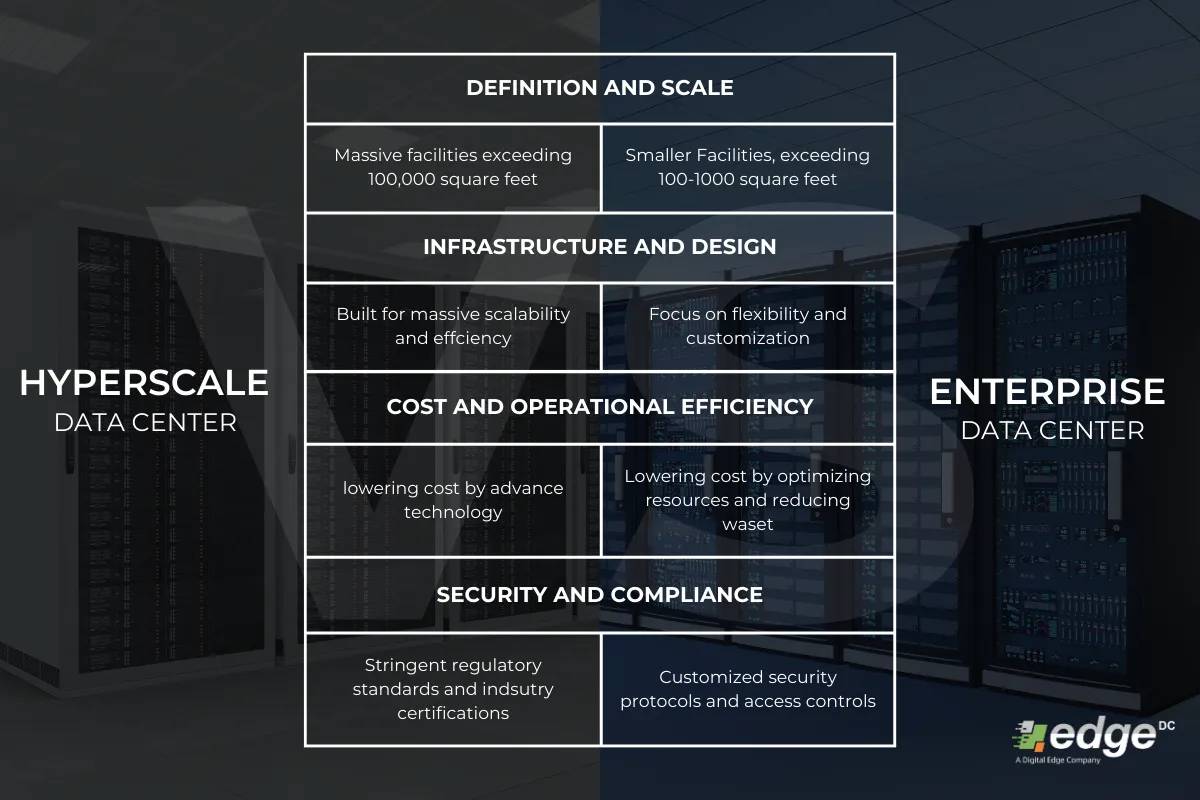
Hyperscale Data Centers: Hyperscale data centers are massive facilities designed to support the expansive and growing needs of tech giants like Amazon, Google, and Microsoft. These data centers are characterized by their enormous scale, often exceeding 100,000 square feet, and their ability to handle vast amounts of data traffic and computational power. They are built to scale up efficiently, supporting thousands of servers and large-scale applications.
Enterprise Data Centers: Enterprise data centers, on the other hand, are typically smaller in scale and cater to the needs of individual businesses or organizations. These data centers range from a few hundred to a few thousand square feet and are designed to handle the specific IT requirements of the company they serve. They provide customized solutions tailored to the enterprise’s applications, data storage, and computing needs.
Hyperscale Data Centers: The infrastructure of hyperscale data centers is built for massive scalability and efficiency. They use modular hardware and standardized designs to facilitate rapid expansion. These facilities often implement advanced cooling solutions, such as liquid cooling and hot aisle containment, to manage the significant heat generated by dense server deployments. Hyperscale data centers also emphasize energy efficiency, employing renewable energy sources and advanced power management systems to reduce their carbon footprint.
Enterprise Data Centers: Enterprise data centers focus on flexibility and customization. They are designed to meet the unique needs of the organization, with a greater emphasis on specific performance metrics and reliability. The infrastructure may include a mix of on-premises and cloud-based resources, tailored to support critical business applications. Cooling and power systems are optimized for the specific requirements of the enterprise, with redundancy and disaster recovery mechanisms to ensure continuous operation.
Hyperscale Data Centers: Hyperscale data centers benefit from economies of scale, which significantly reduce the cost per unit of computing power and storage. Their operational efficiency is enhanced by advanced automation, streamlined management processes, and bulk purchasing of hardware. These factors contribute to lower overall costs and higher efficiency in delivering services.
Enterprise Data Centers: On the other hand, enterprise data centers, while potentially more expensive per unit of computing power compared to hyperscale, provide cost efficiencies through tailored solutions that align closely with business needs. They may not achieve the same economies of scale, but their focused approach can result in cost savings by optimizing resources and reducing waste.
Hyperscale Data Centers: Security in hyperscale data centers is robust, with multiple layers of physical and cyber protection. These centers must comply with stringent regulatory standards and industry certifications to ensure data integrity and privacy. Advanced threat detection and mitigation strategies are implemented to safeguard against cyberattacks and data breaches.
Enterprise Data Centers: Security in enterprise data centers is equally critical, with measures tailored to the specific risks faced by the organization. Compliance with industry regulations and standards is a key focus, ensuring that sensitive data is protected. Enterprise data centers often implement customized security protocols and access controls to meet the unique requirements of their business operations.
If your business is rapidly growing or requires high-performance computing, a hyperscale data center might be the better choice. For smaller businesses with stable data needs, an enterprise data center could be more suitable.
If security and control over the data center are paramount, an enterprise data center might be the better option. For businesses that prioritize scalability and cost-effectiveness, hyperscale data centers could be more suitable.
If you need to integrate your data center with cloud services, hyperscale data centers are often more compatible with cloud infrastructure.
Consider your budget and resources when choosing between hyperscale and enterprise data centers. Hyperscale data centers can be more expensive to build and maintain, while enterprise data centers may require more technical staff for operation and maintenance.
Ultimately, the choice between hyperscale and enterprise data centers depends on your specific business needs and priorities. It is essential to weigh the pros and cons of each option carefully before making a decision.
Hyperscale and enterprise data centers play vital roles in modern digital operations, each offering distinct benefits. Hyperscale centers prioritize scalability, efficiency, and cost-effectiveness for large-scale applications, while enterprise centers focus on customization, flexibility, and tailored solutions for individual businesses. Differentiating between these types helps organizations select the ideal data infrastructure to support their growth and operational requirements.
At EDGE DC, we bring your digital business closer to end-users with a comprehensive suite of networking, reliable infrastructure, and personalized solutions. Our data centers are designed to provide unparalleled scalability, efficiency, and security, ensuring your business can thrive in the digital age. It’s time to establish a robust foundation for long-term success. Contact our team below to embark on your AI journey and discover how EDGE DC can transform your data infrastructure for the future
In our fast-paced digital era, data centers are the powerhouse behind the digital services we rely on every day. These facilities, essentials for cloud computing, big data analytics, and AI, are substantial energy consumers. With the growing demand for data processing and storage, the environmental impact of data centers has become a significant concern. To address this challenge, the rise of green data centers emphasizes a harmonious blend of efficiency and eco-friendliness.
Conventional data centers are well known for their high energy usage. According to the International Energy Agency (IEA), data centers and data transmission networks account for nearly 1% of global electricity demand. This figure is expected to rise as digitalization progresses. The carbon footprint of these facilities is substantial, contributing to global greenhouse gas emissions.
Moreover, the cooling systems required to maintain optimal operating temperatures consume a large portion of this energy. Traditional air conditioning systems are not only energy-intensive but also often rely on refrigerants that can be harmful to the environment.
Leading companies are committing to powering their data centers with renewable energy. Google, for example, has been matching its energy usage with 100% renewable energy purchases since 2017. By investing in solar, wind, and hydroelectric power, data centers can significantly reduce their reliance on fossil fuels.
Advanced cooling techniques, such as liquid cooling and free cooling, offer more efficient alternatives to traditional air conditioning. Liquid cooling involves circulating coolants directly to the heat-generating components, which is more effective and less energy-intensive. Free cooling leverages natural environmental conditions, such as outside air or water sources, to cool data centers, reducing energy consumption significantly.
Implementing energy-efficient hardware and optimizing data center design can lead to significant energy savings. Technologies such as solid-state drives (SSDs) consume less power than traditional hard drives. Additionally, optimizing server utilization through virtualization and implementing AI-driven energy management systems can improve overall energy efficiency.
Investing in green data centers is not just about environmental stewardship; it also makes economic sense. Energy-efficient operations translate into lower electricity bills, which are a significant portion of a data center’s operational costs.
As Implemented in Indonesia, The Ministry of Communication and Information Technology (Kominfo) is promoting the development of Green Data Centers using renewable energy more efficiently, essential for the growing data demands of the metaverse. Investing in these centers is both environmentally responsible and economically beneficial, reducing operational costs and enhancing brand reputation. By prioritizing sustainability, companies can attract eco-conscious customers and investors, comply with increasingly stringent regulations, and benefit from government incentives. Additionally, since 2017, The Indonesian Ministry of Communication and Information Technology (Kominfo) has been developing Smart City Master Plans for 141 cities and regencies, leveraging digital innovations like digital twins to create sustainable, efficient urban environments.
Green data centers are leading the way in meeting the rising demands of the digital age while addressing the urgent need for environmental sustainability. By adopting renewable energy sources, innovative cooling technologies, and energy-efficient practices, these advanced technology hubs can minimize their carbon footprint without compromising performance. As technology progresses, the dedication to sustainable practices in data centers will be essential for a greener digital future.
At EDGE DC, we bring your digital business closer to end-users through a sustainable data center, dependable infrastructure, and customized solutions. Establish a solid foundation for long-term success by contacting our team below to balance performance and sustainability for your business
Data centers are the heart of smooth business operations in the digital era. However, with technological advancements and evolving business needs, migrating data centers to newer infrastructure or different locations becomes inevitable.This migration has significant impacts, both positive and negative. On one hand, it can enhance performance, scalability, and data security. On the other hand, its complex process risks disrupting business operations if not carefully planned and executed.The common question is: How can you perform an efficient data center migration with minimal downtime? This article will discuss in detail the strategies needed to achieve a successful data center migration.
Choosing the right data center migration strategy is crucial to ensure smooth operations and minimize downtime. Here are detailed explanations of three commonly used data center migration strategies:
Big Bang Migration is the simplest and fastest data center migration method. In this strategy, all data and applications are migrated from the old system to the new system simultaneously. Big Bang Migration is suitable for:
Parallel Migration is a safer and more controlled data center migration method than Big Bang Migration. In this strategy, data and applications are gradually migrated from the old system to the new system. Parallel Migration is suitable for:
Blue-Green Deployment is the most modern and safest data center migration method. In this strategy, two identical environments (blue and green) run in parallel. The blue environment is the old environment, while the green environment is the new environment. After the new applications are tested and validated in the green environment, traffic is then switched to the green environment. Blue-Green Deployment is suitable for:
Read more: The Role of Data Centers and New Technology in Indonesia’s Digital Economy
Data center migration is a complex process that can disrupt business operations. To minimize downtime and ensure a smooth migration, here are some practical tips you can follow:
Read more: Definition of Data Centers, Along with Their Functions and Types
Data center migration is a complex process that requires thorough planning, careful preparation, and precise execution to minimize downtime and ensure smooth business operations.The best data center migration strategy for you depends on your business needs and conditions. It’s important to remember that every data center migration is different. You need to tailor the migration strategy to your business’s needs and conditions.EDGE DC, as a trusted data center expert, offers comprehensive and secure data center solutions to help you perform efficient data center migrations with minimal downtime.Contact EDGE DC today to learn more about how we can assist you in achieving a successful data center migration!Read more: Why Choose EDGE DC as Your Company’s Data Center?
In today’s digital era, data center connectivity is key to business continuity and growth. Like the brain of the human body, the data center stores, processes, and distributes vital data for business operations. Data centers connect various devices and networks, enabling smooth data exchange and communication.
Optimal data center connectivity can enhance operational efficiency, increase productivity, and provide a better customer experience. However, many businesses still face slow and unstable data center connectivity. This can lead to various losses, such as missed revenue opportunities, reduced productivity, and customer dissatisfaction.
One solution to address data center connectivity issues is using Cross Connect. This article will discuss the use of Cross Connect and how to maximize it to improve data center connectivity in detail.
Cross Connect is a direct physical connection between two or more data centers that allows high-speed data exchange with low latency. Unlike public internet connections that traverse general networks, Cross Connect provides an exclusive path for data transfer between data centers operated by the same or different companies.
Cross Connect can be used to connect your data center with other networks, such as:
Read more: Exploring The Role of Cross Connect in a Data Center
Cross Connect offers many benefits for data center connectivity, including:
Read more: The role of IP Transit in Data Center Connectivity
Maximizing data center connectivity to be more profitable with Cross Connect requires careful strategy and planning. Here are some tips that can help:
EDGE DC, as a trusted data center expert, offers comprehensive and secure Cross Connect solutions to help you maximize data center connectivity and increase your business profits.
We are a company that provides comprehensive Cross Connect services and has years of experience in helping businesses build reliable and cost-effective data center networks.
Contact EDGE DC immediately to learn more about how we can help you build stable and secure data center connectivity with Cross Connect, thus increasing your future profits.
Read more: 5 EDGE DC Services for Data Center in Indonesia